
The Agentic Operating System: Inside Microsoft Build 2026's Quiet Revolution
Moving beyond chat-based "tokenmaxxing" to multi-worktree execution, sandboxed kernels, and the brutal macroeconomic realities of consumption billing.

The relocation of Microsoft Build 2026 to San Francisco’s Fort Mason Center was not merely a geographic pivot; it was a structural declaration. After a decade of hosting the event in its traditional Seattle environment, the shift placed Microsoft physically and culturally in the epicenter of the generative AI boom, directly positioned chronologically between Google I/O and Apple’s WWDC. Behind the breezy San Francisco bay views, however, lay a hard engineering truth: the era of the stateless, prompt-driven AI chatbot is over. Build 2026 marked the official arrival of the autonomous agentic framework as a first-class citizen of enterprise software architecture.
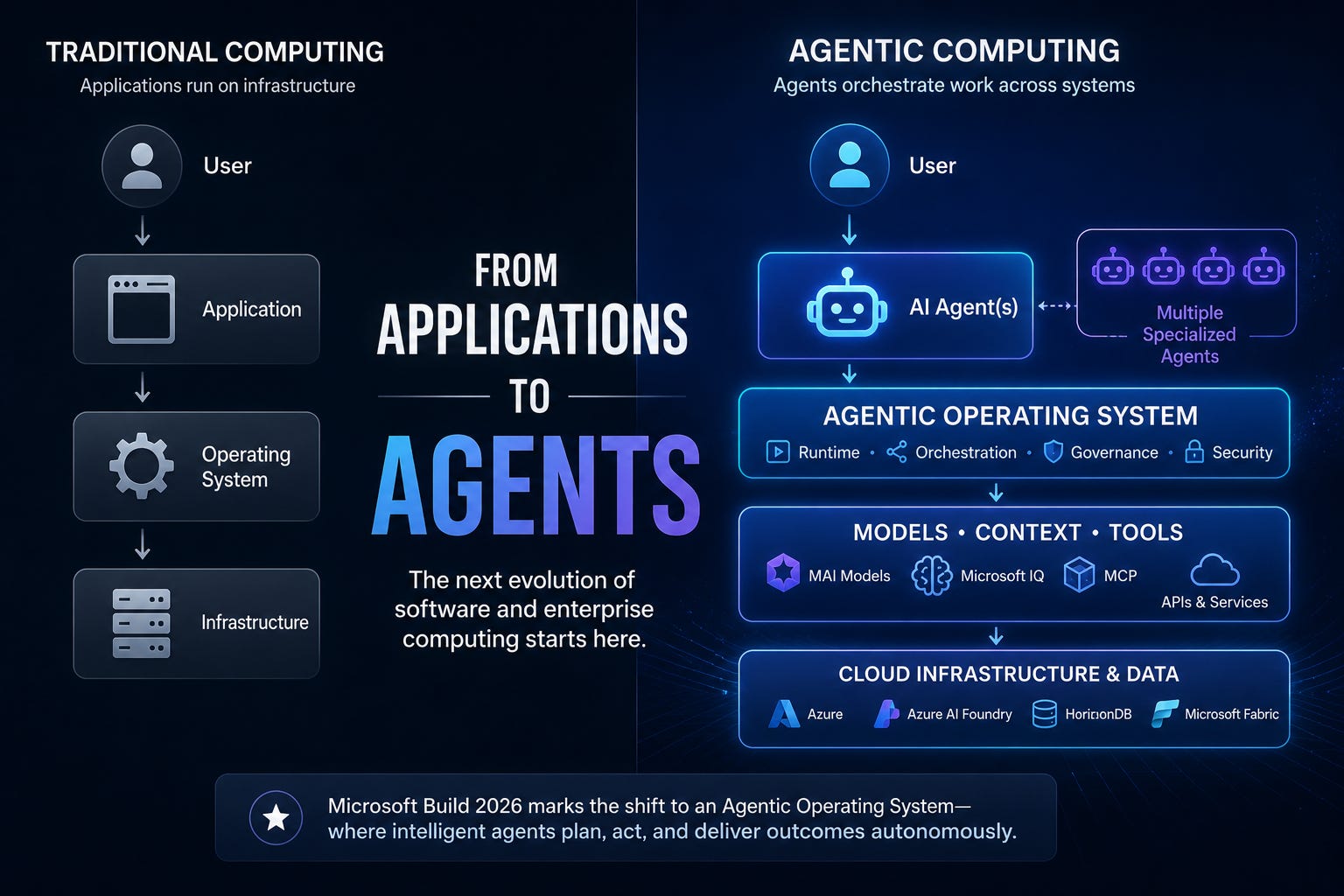
Rather than showcasing superficial Copilot buttons, Satya Nadella and his engineering team spent their keynotes mapping out a highly unified, five-layer agentic stack designed to run across native operating systems, edge hardware, and serverless runtimes. This represents a fundamental shift in how we build and scale applications. We are transitioning from “synchronous assistants” to “asynchronous coworkers” that execute long-running, multi-step workflows across databases, codebases, and systems without constant human prompting.
Yet, this shift is not without friction. As autonomous loops begin executing hundreds of daily code edits, API calls, and validation runs, the industry has hit two massive walls: a sudden macroeconomic transition to metered, token-based pricing that has triggered immediate developer backlash , and physical power constraints that are prompting statewide bans on new data center infrastructure. For cloud architects, AI engineers, and technology leaders, Build 2026 provides a stark roadmap of how to architect for this new world—and how to survive its costs.
Section 1: From AI Assistants to Autonomous Agents
The architectural narrative of Build 2026 centers on a single transition: moving from active, synchronous prompt engineering to passive, asynchronous workflow orchestration.
In traditional generative AI systems, the human is the active runtime loop. The developer enters a prompt, waits for an answer, copies code, tests it, and enters another prompt. This synchronous model fails when scaled to enterprise workflows. A real enterprise agent—software that can take steps on your behalf—requires compute to run on, permission to access files, an identity so the company knows who did what, memory of the task, tools it can safely use, and an audit trail for IT inspection.
At Build 2026, Microsoft showcased this transition through Microsoft Scout, an “always-on” autopilot personal agent built on the open-source OpenClaw agentic harness and powered by the new Microsoft IQ context engine. Operating quietly in the background across Teams, Outlook, OneDrive, and SharePoint, Scout doesn’t wait for a prompt. It proactively manages scheduling conflicts, prepares meeting briefs, and triages legacy workflows.
To make this governable, Scout operates with its own Entra Agent ID. This gives the agent a distinct organizational identity, allowing IT administrators to monitor what files it accesses and control what actions it is allowed to perform.
Consider a real-world enterprise scenario: an outbound shipping triage agent. Under the old assistant paradigm, a human clerk would ask an AI chatbot to identify late orders in a database, copy the list, and write emails to carriers manually.
In the new agentic paradigm, an event-driven serverless agent is triggered by a database write. The agent automatically retrieves shipping context via the Model Context Protocol (MCP), invokes carrier APIs inside a secure operating-system sandbox, resolves the address error, writes the update back to the database, and only alerts a human operator if a high-cost commercial exception occurs.
Section 2: Microsoft’s Five-Layer Agentic Stack
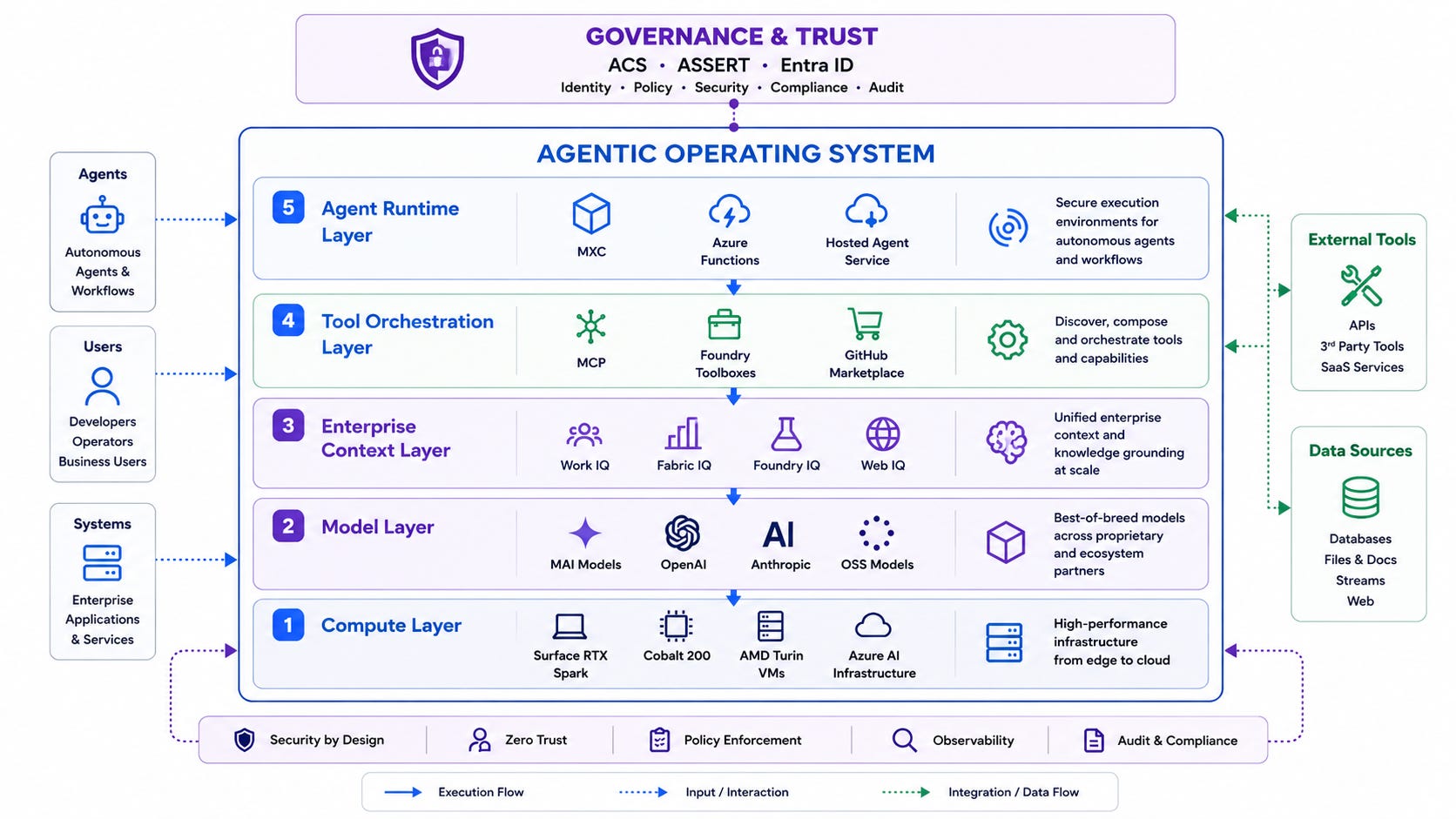
To support this shift, Satya Nadella introduced a structured, five-layer conceptual model for agentic computing. This framework moves away from treating AI as an isolated API call and instead treats it as a comprehensive system running on specialized infrastructure.
1. Compute (Local & Cloud)
At the base, agentic scaling requires raw silicon optimized for continuous, low-latency execution. Locally, Microsoft introduced the Surface RTX Spark Dev Box, a compact workstation powered by NVIDIA’s RTX Spark chip delivering up to one petaflop of local AI performance and 128GB of unified memory—allowing developers to run models up to 120 billion parameters completely offline. In the cloud, Microsoft rolled out ARM-based Azure Cobalt 200 VMs offering a 50% performance improvement optimized for continuous agent loops, alongside high-throughput AMD EPYC “Turin” VMs.
2. Models
The intelligence layer has transitioned from model-monopoly to model-diversity. Microsoft’s proprietary MAI model family runs alongside partner models (OpenAI, Anthropic, Gemini) hosted on Microsoft Foundry.
3. Context
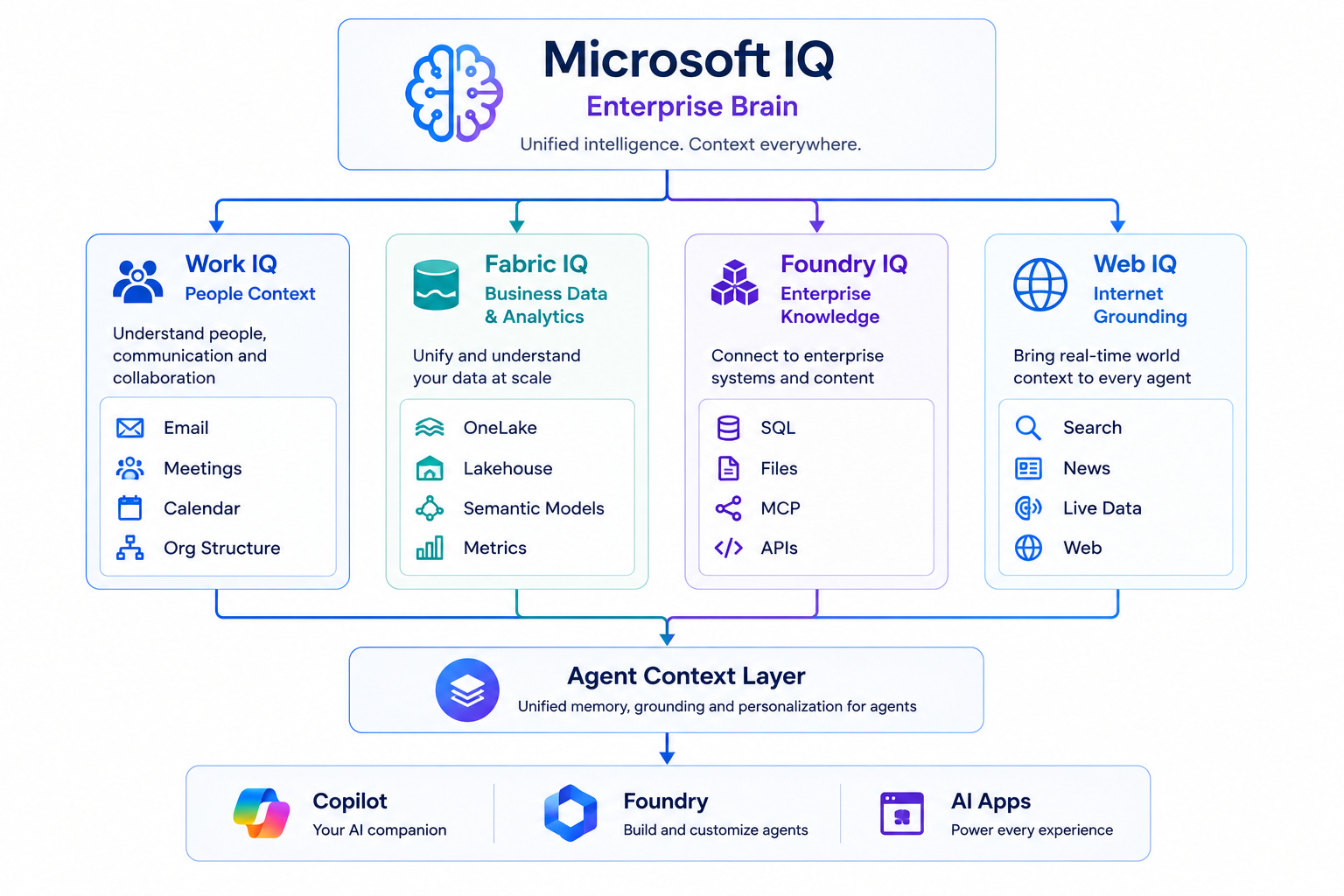
Agents require persistent memory and grounded enterprise data. This is managed by Microsoft IQ, an enterprise intelligence layer that maps calendars, email, data lakes, and real-time web streams to establish a shared, continuously updated understanding of how the business works.
4. Tools
Agents need hands to interact with the world. This is accomplished via Toolboxes in Foundry and native integration of the Model Context Protocol (MCP), which exposes databases, carrier APIs, and local filesystems as standard, discoverable services.
5. Runtime
The execution engine that runs the agent loops. Locally, this is handled by Microsoft Execution Containers (MXC) inside Windows 11; in the cloud, it runs inside the Foundry Agent Service and serverless Azure Functions.
Why This Resembles a Modern OS In traditional cloud architectures, applications treat the AI model as an external, stateless database. The Five-Layer Stack mirrors a classic operating system: the Runtime serves as the process isolation engine; the Context acts as virtual memory; the Tools behave like device drivers; and the Models serve as the CPU. The entire stack is wrapped in governance standards like the Agent Control Specification (ACS) and ASSERT, establishing secure system-call boundaries.
Section 3: The MAI Model Family and Microsoft’s AI Independence Strategy
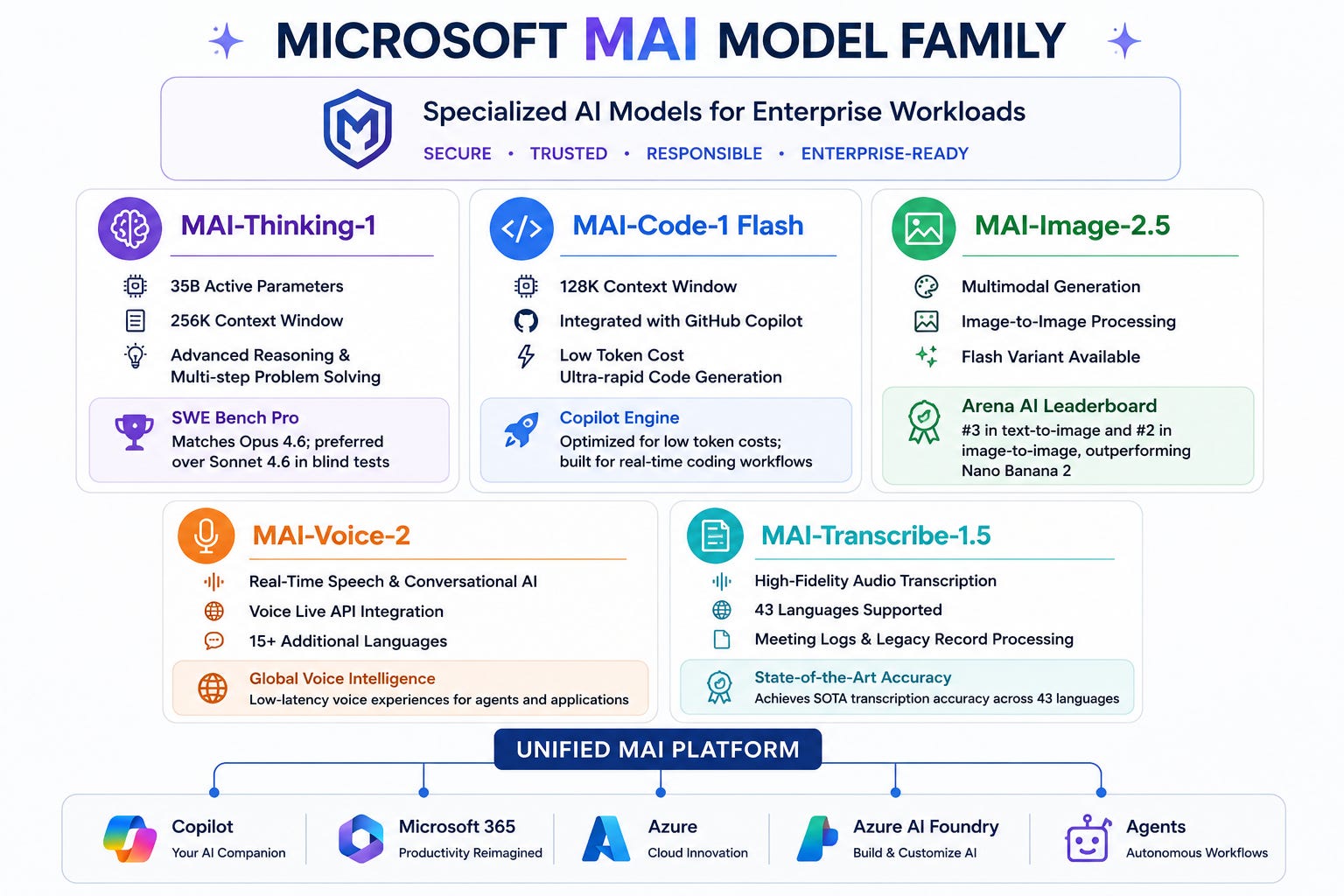
One of the most significant architectural announcements at Build 2026 was Microsoft’s “AI Independence Day”. By launching the proprietary, in-house MAI model family, Microsoft is actively decoupling its technical stack from its long-standing, exclusive reliance on OpenAI.
The MAI models are designed for targeted, high-efficiency task execution rather than general-purpose, high-cost chat prompting.
Enterprise Benefits
Data Sovereignty: Because the MAI models are trained from scratch with zero distillation on clean, commercially licensed, enterprise-grade data, organizations can deploy them inside compliance boundaries without intellectual property risks.
Performance-to-Cost Optimization: Mid-sized reasoning models like MAI-Thinking-1 offer a high-efficiency design that significantly reduces token costs.
Unified Model Lifecycle: Available via the Microsoft Playground platform, developers can transition from cloud-based testing to local edge deployment seamlessly.
Risks and Limitations
At present, Microsoft officially classifies these models as experimental and in “limited preview”. Early community feedback indicates that while they excel at structured reasoning and code generation, they lack the broad, generalized capabilities of larger frontier models.
There is a risk that developers might experience minor regressions in raw conversational fluidity if they attempt to use MAI models for open-ended, unstructured enterprise search.
Architect’s Take: The Economics of “Vibe Coding”
The release of MAI-Code-1-Flash explicitly caters to “vibe coding”—a trend where developers generate large features using high-level instructions and real-time visual feedback rather than manually writing lines of code.
While this dramatically reduces initial prototyping speed, it introduces a major technical debt risk. Unchecked generation of code can quickly lead to fragmented, unmaintainable architectures.
As architects, we must enforce rigorous, automated unit and integration tests at the pull request boundary using specialized agent guidelines to ensure “vibe coding” does not degrade our codebase health.
Section 4: Windows Becomes an Agent Runtime
One of the most practical developments at Build 2026 is that Windows 11 has been redesigned as a native local runtime for agents. This represents a deliberate shift away from unmanaged, raw terminal execution toward operating system-controlled agent containment.
Microsoft Execution Containers (MXC)
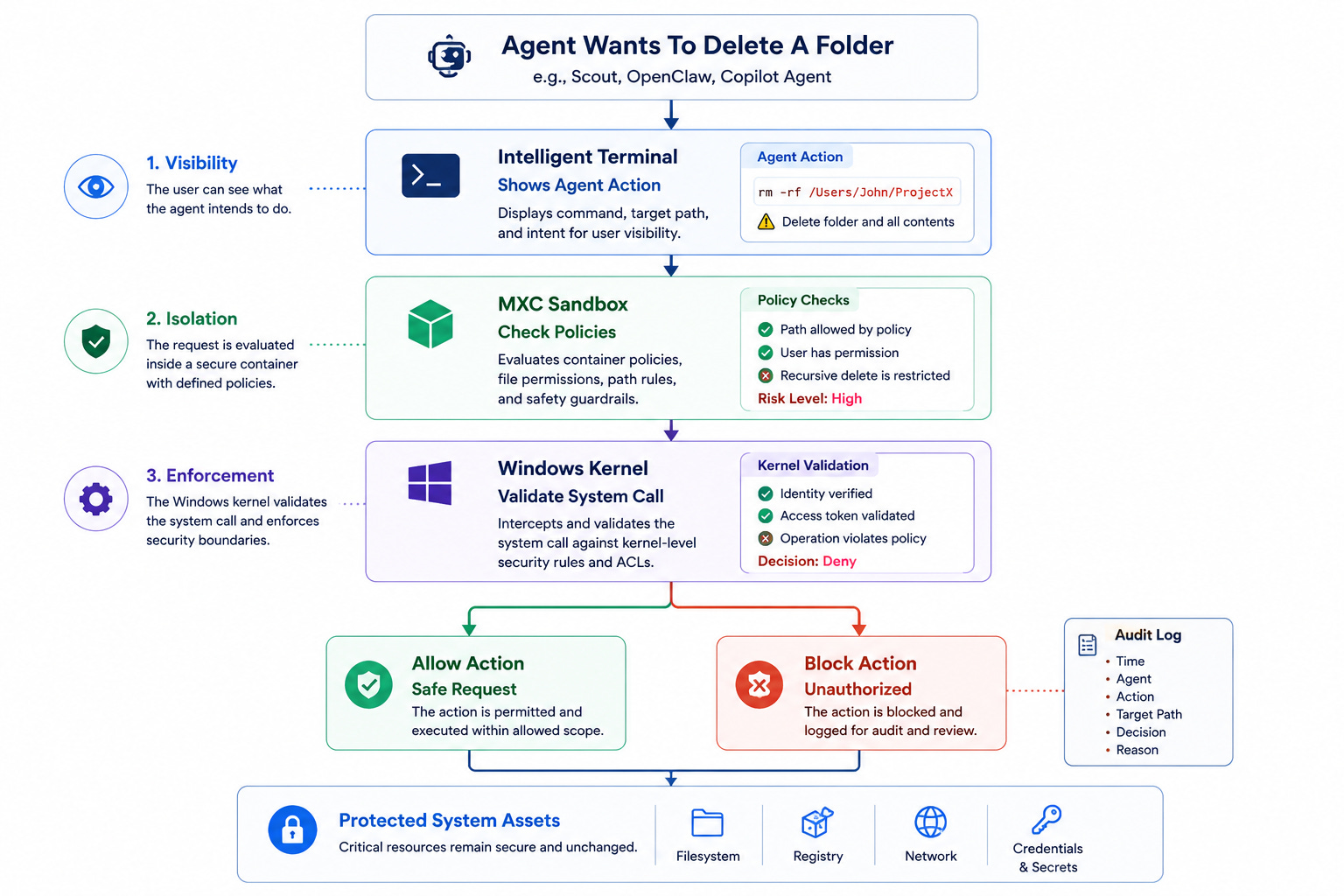
MXC (currently in preview) is an operating system-enforced sandbox that allows developers to set strict security policies around local agent access. When an agent executes multi-step workflows locally, MXC intercepts low-level system calls.
During a keynote demonstration, an OpenClaw agent attempting a destructive action—deleting a protected directory of user files—was blocked at the kernel boundary by MXC policies. This sandboxed containment is a massive win for SecOps, giving security teams a reliable way to approve developer agent tools without exposing local workstations to unauthorized modification.
Intelligent Terminal 0.1
This open-source, experimental fork of the Windows Terminal introduces native agent integration via the Agent Client Protocol (ACP). The terminal features an Agent Pane that acts as a pair-programmer in the shell, possessing direct access to the terminal’s output stream.
If a build command or deployment script fails, the terminal automatically feeds the console output and error context directly into the Agent Pane. The agent can then analyze the failure and suggest or execute a fix directly within the shell, eliminating the need to manually copy and paste errors into external browser windows.
Windows Development Skills
Now generally available, Windows Development Skills provide agents with structured, platform-specific knowledge of native WinUI 3 APIs and the WinApp CLI. Instead of requiring a general-purpose model to guess platform patterns, these skills guide agents through the end-to-end inner loop of native application construction: scaffold -> design -> build -> run -> test -> package -> ship.
Section 5: Microsoft IQ – The Missing Piece of Enterprise AI
The industry-wide focus in agentic development has shifted: data context has replaced raw model capability as the primary bottleneck for enterprise AI adoption. As the 2026 Work Trend Index highlights, today’s models are highly capable, but every new agent starts from zero, spent relearning where organizational data lives, who reports to whom, and what business rules to follow.
To bridge this gap, Microsoft introduced Microsoft IQ, an enterprise intelligence layer that unifies semantic signals across the Microsoft stack to give agents a shared, continuously updated understanding of how an organization operates.
Work IQ
Focusing on workplace context, the Work IQ APIs (generally available June 16, 2026) expose M365 collaboration data, calendar patterns, email flows, and organizational charts inside the tenant’s security boundary across four domains: Chat, Context, Tools, and Workspaces.
Fabric IQ
Now generally available, Fabric IQ curates semantic meaning by harmonizing definitions of organizational assets (customers, orders, revenues) in Microsoft OneLake. This ensures that when an agent queries “active accounts,” it references the same semantic definitions used by corporate finance, preventing data fragmentation.
Foundry IQ
Generally available, Foundry IQ serves as a dedicated, SLA-backed retrieval endpoint unifying Azure SQL, local files, and external MCP sources under a serverless tier to streamline retrieval-augmented generation (RAG).
Web IQ
To provide real-time world grounding, Web IQ integrates Bing search results directly into the agent’s context window with latencies under 200 milliseconds.
Section 6: Azure HorizonDB and the Rise of AI-Native Databases
A major challenge for database administrators in the AI era is managing transactional data alongside massive vector spaces. To solve this, Microsoft launched Azure HorizonDB into public preview, positioning it as an enterprise-ready PostgreSQL-compatible database engineered specifically for modern AI applications.
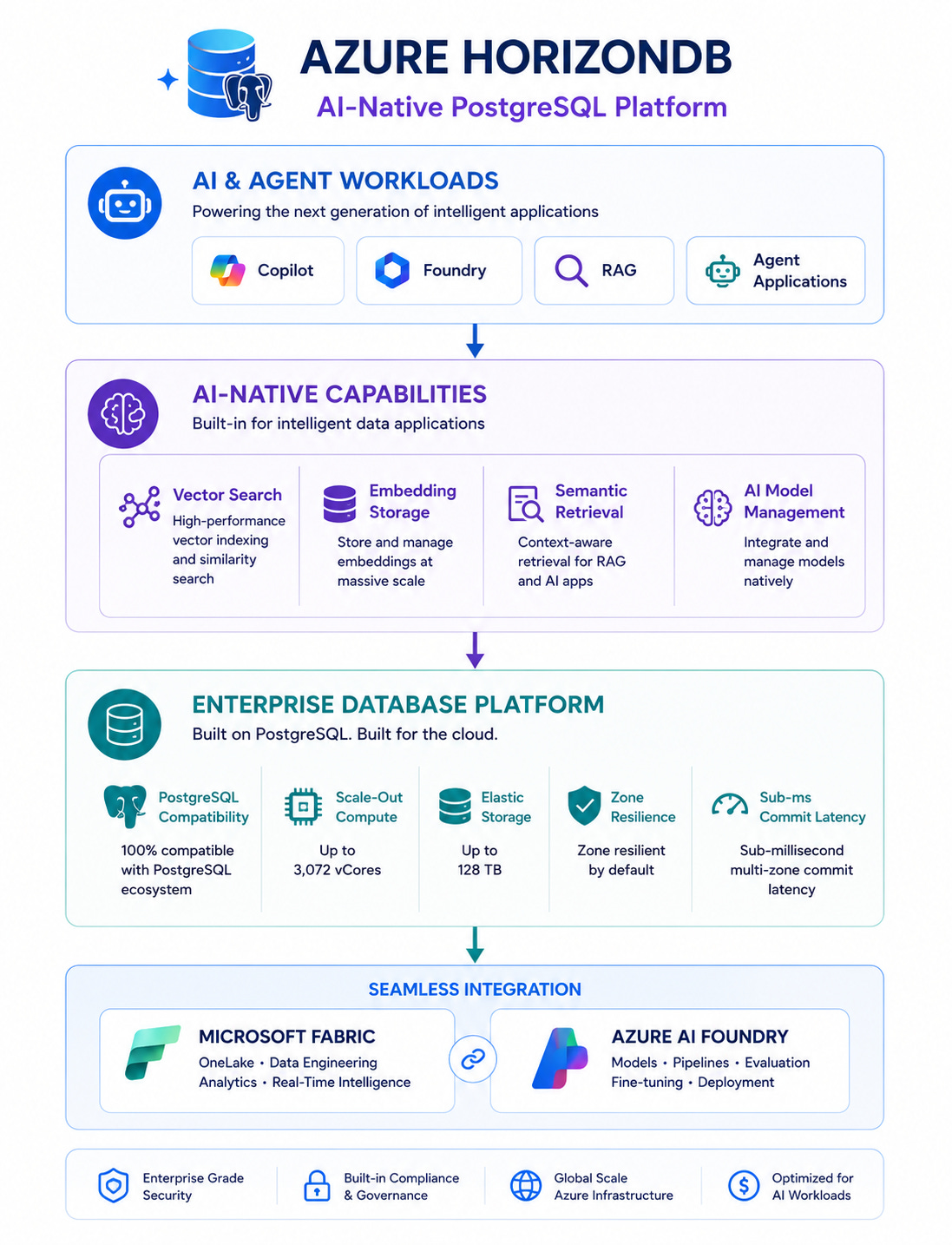
HorizonDB unifies transactional workloads and high-density vector indexing within a single, highly resilient engine. Adopted by financial institutions like NASDAQ, HorizonDB supports up to 3,072 vCores of scale-out compute and 128TB of elastic storage, ensuring that high-concurrency vector lookups do not bottleneck core business transactions.
To support local testing, the Azure Cosmos DB Linux Emulator is now generally available. This enables developers to build, test, and run vector workloads locally across macOS, Linux, and Windows, shortening feedback loops and removing cloud billing dependencies from continuous integration (CI) pipelines.
Furthermore, a new Agentic Memory Toolkit (built on Cosmos DB, Azure Durable Functions, and Foundry models) standardizes how persistent agent memory is stored and retrieved across sessions, ensuring agents retain facts like user preferences without bloating conversational contexts.
Architect’s Design Recommendation
When architecting database engines for AI agents, avoid splitting vector search and transactional operations into separate physical databases. This multi-database pattern leads to sync delays, data duplication, and security misconfigurations.
By standardizing on a PostgreSQL-compatible engine like HorizonDB or utilizing Cosmos DB with the Agentic Memory Toolkit, you ensure sub-millisecond, transactional consistency for both structured records and vector embeddings in a single security boundary.
Section 7: GitHub Copilot Becomes an Agent Platform
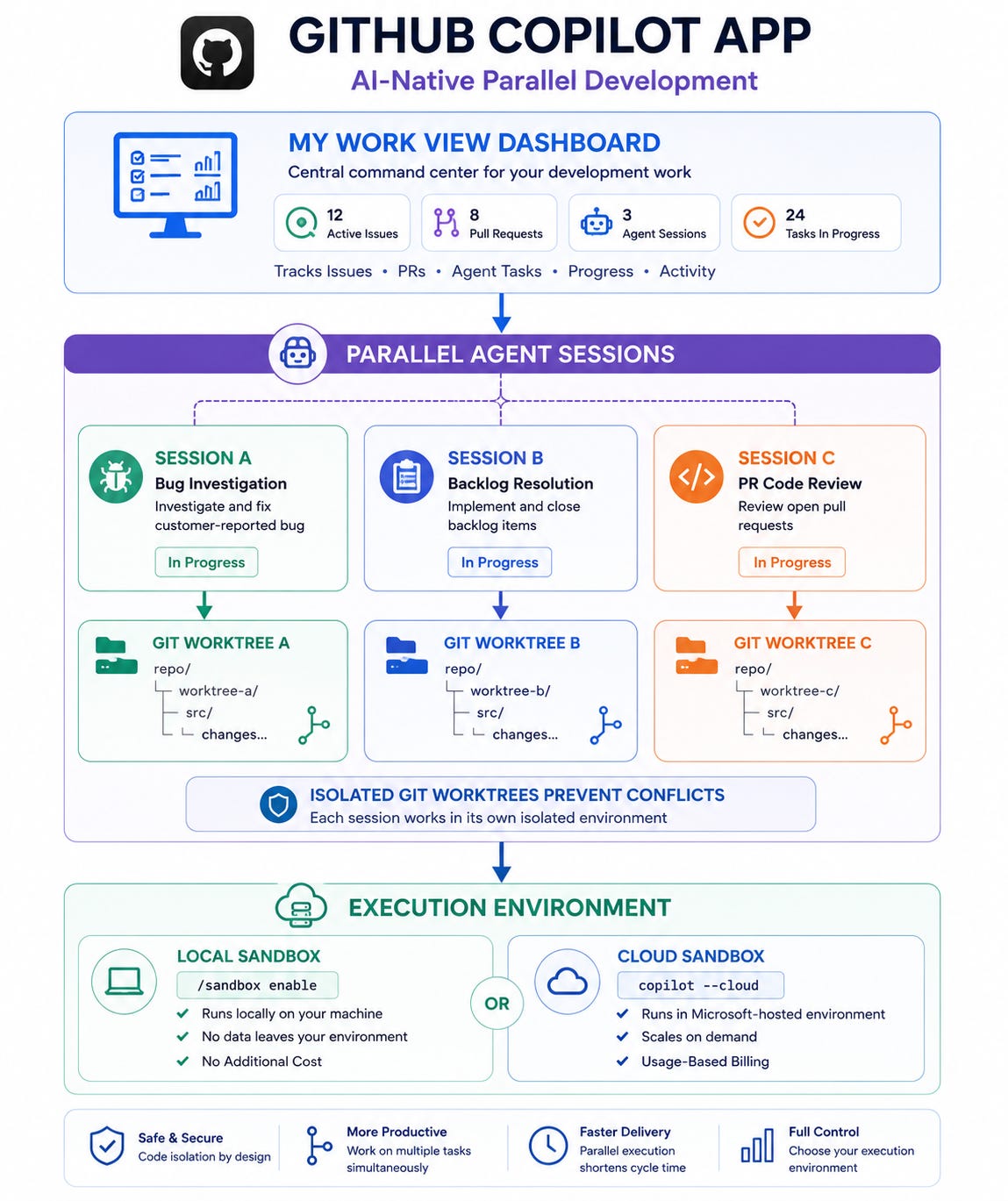
As software development workflows shift to support parallel execution, GitHub has transformed Copilot from an inline auto-completion tool into a desktop control center. The GitHub Copilot App (currently in technical preview) acts as an agent-native desktop dashboard designed to direct and manage multiple parallel initiatives.
Automated Git Worktrees
When multiple agents run in parallel, they can create file conflicts if they write to the same workspace directory. To prevent this, the Copilot App automatically provisions isolated Git Worktrees.
Every agent session runs in its own physical copy of the repository branch, with branch configuration, setup, and post-execution cleanup handled automatically behind the scenes. This allows developers to track background agents in a unified My Work View without worrying about local code pollution.
Local vs. Cloud Sandboxing
To allow agents to run code, test modifications, and execute commands safely, GitHub introduced a dual-sandbox framework :
Local Sandboxing: Enabled by running
/sandbox enablein the shell, this restricts agent filesystem and network access locally at no additional cost.Cloud Sandboxing: Running
copilot --cloudprovisions an ephemeral, fully isolated Linux container hosted on Azure Container Apps, offloading resource-heavy tasks completely from the local machine.
Copilot Code Review
With agents producing an accelerated volume of code, manual code reviews can quickly become a bottleneck. Copilot Code Review introduces an automated system to filter out review noise. Developers can place custom instructions in a .github/copilot-instructions.md file in the repository’s base branch to guide the agent’s review guidelines.
For complex pull requests, a new Medium Analysis Tier routes reviews to a higher-reasoning model. This is supplemented by specialized commands like /security-review to pinpoint vulnerabilities and /rubberduck for interactive discussions.
Scenario: How a.NET Team Uses This Workflow
A developer on a.NET team starts their day with an assigned Blazor bug. Using the GitHub Copilot App, they delegate the bug to an agent. The app automatically provisions an isolated Git Worktree, runs compilation checks, captures a runtime exception, and proposes a fix.
To verify the changes safely, the developer runs the code inside a local sandbox using /sandbox enable. Once verified, the developer pushes the branch. The pull request triggers Copilot Code Review, which automatically reads .github/copilot-instructions.md to ensure company-specific C# styling and Blazor design guidelines are followed before a human reviewer is ever assigned to merge the code.
Section 8: Azure Functions and Serverless Agents
Deploying event-driven agents has historically required complex cloud infrastructure setup. At Build 2026, Microsoft launched a serverless programming model for AI agents within Azure Functions. Developers can define an agent natively by creating a single .agent.md file.
Order Verification Agent
Verify shipping address accuracy for inbound transactional orders.
Triggers
Event: Cosmos DB Log Insert
Tools
Name: AddressVerificationService
Connection: Managed Connector (FedEx)
Permissions: Write Access
This markdown schema acts as a declarative manifest. The Azure Functions runtime parses this file, provisions the event triggers, and maps tool permissions automatically, removing the need for developers to write boilerplate infrastructure code.
Model Context Protocol (MCP) Integration
The Azure Functions MCP extension natively supports the complete set of MCP primitives (tools, resources, and prompts) across.NET, Java, Python, TypeScript, and JavaScript. This allows functions to act as “MCP Apps,” enabling serverless backends to return rich, interactive UI widgets directly to compatible chat clients instead of raw, unformatted text.
Idiomatic Go Language Support
For teams requiring high performance and low startup times, Azure Functions introduced Go as a first-class language on Flex Consumption. The programming model is idiomatic, leveraging standard HTTP handlers and basic Go modules (go build, go test). This is supported by the new v5 Flex CLI, which features an interactive TTY console dashboard with keyboard shortcuts and live log navigation to streamline local testing.
Section 9: The Economics of Agentic Computing
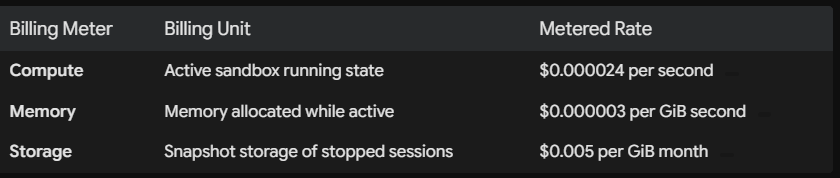
While parallel agentic workflows promise immense gains in developer productivity, they have introduced a harsh financial reality: on June 1, 2026, Microsoft officially transitioned GitHub Copilot to metered, token-based billing.
During the early years of generative AI development, platform providers heavily subsidized access through predictable, flat-rate monthly subscriptions. However, the rise of recursive, multi-step agent loops—where a single human instruction can trigger an agent to run dozens of parallel tool calls, filesystem writes, and compilation checks—has caused token consumption to skyrocket, exposing the monthly flat-rate model as a financial impossibility.
Under the new billing model, flat-rate monthly subscriptions no longer provide unlimited usage. Instead, they function as a monthly credit allowance, where 1 GitHub AI Credit is equivalent to $0.01. Credits are consumed dynamically based on input, output, and cached token processing.
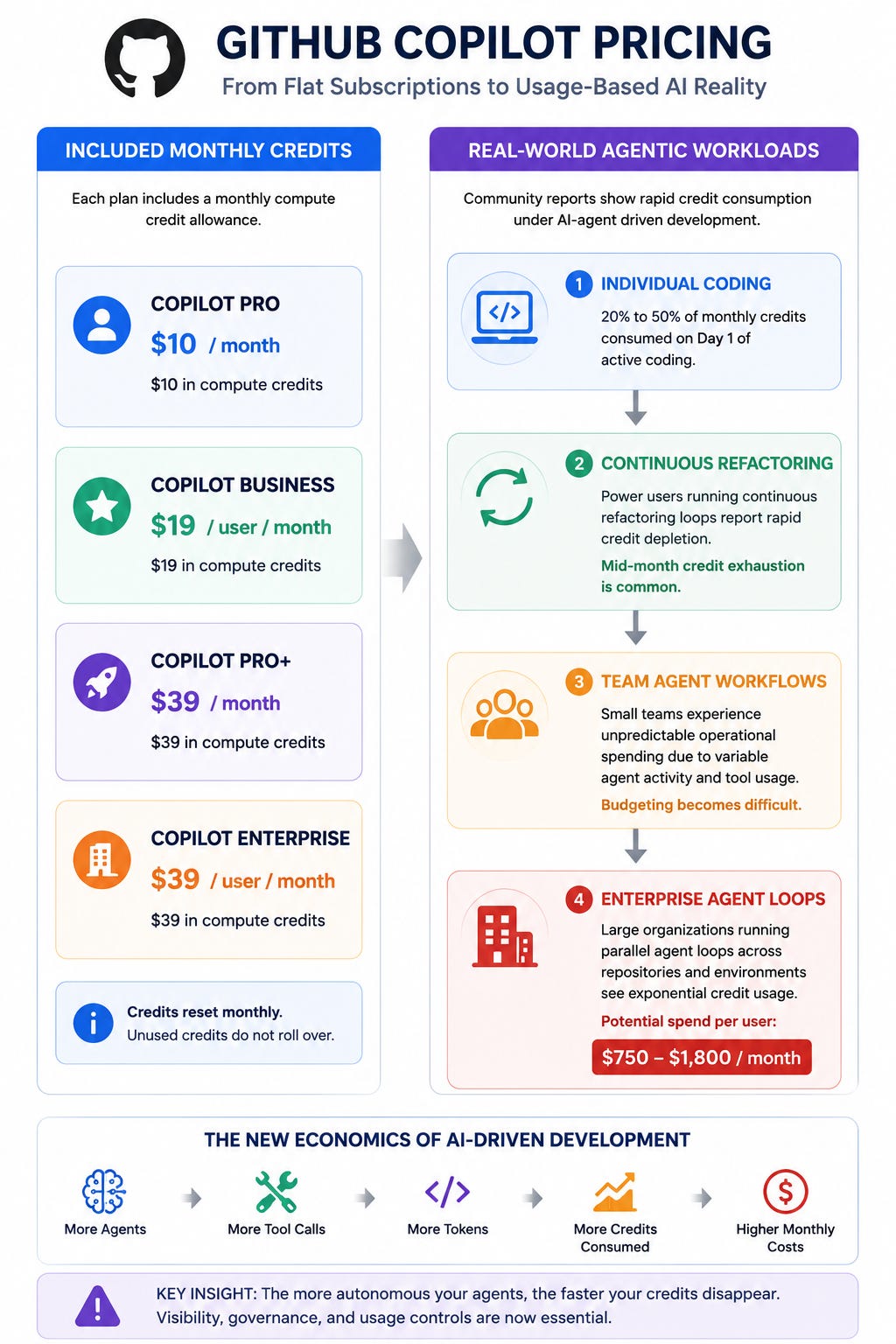
This change has triggered a strong backlash across community forums like Reddit and Hacker News. Developers complain that Copilot has transitioned from an empowering utility into an unpredictable cost center, with some warning of monthly costs scaling to $20,000 for highly active enterprise teams.
Neither GitHub nor Microsoft has directly addressed the backlash, choosing instead to publish documentation on budget optimization. In response, many developers are switching to alternative tools, using open-source models, or leveraging Visual Studio 2026’s BYOK capabilities to run local, non-metered inference engines.
Will AI become the next cloud cost optimization problem?
Yes. AI is transitioning from an experimental tool into a major cost center, mimicking the early days of unmanaged cloud migration. FinOps will soon need to monitor token consumption just as they monitor VM compute hours.
Benefits
Encourages developers to write clean, optimized, and targeted agent prompts.
Promotes token-efficiency through caching, reducing duplicate query expenses.
Risks
Cost unpredictability can create developer “credit anxiety,” leading teams to pause workloads mid-month.
High risk of “billing shock” from recursive, runaway agentic loops.
Cost-Control Recommendations
Route non-critical developer tasks to cheaper, local edge hardware like the Surface RTX Spark Dev Box.
Utilize Visual Studio 2026’s BYOK capability to connect custom local or open-source models.
Establish daily and weekly credit budget caps at the enterprise admin level to prevent runaway billing.
Section 10: The Physical Limits of AI
While developers interact with agents through clean software interfaces, the scale-out of these systems is limited by physical constraints. The massive computational requirements of continuous agentic loops have led to a rapid expansion of physical data centers, running into growing environmental, regulatory, and public resistance.
National polling indicates that 7 in 10 Americans now oppose the construction of new data centers in their local areas, citing concerns over grid reliability, carbon emissions, and rising energy costs. This public concern resulted in a major legislative development during the week of Build 2026, with the New York State Legislature passing a landmark one-year ban on all new data center construction. This bill represents the first statewide moratorium on data center construction in the United States, targeting the physical foundation of modern AI.
This tension was felt at Build 2026, with community groups protesting data center expansion at the entrance of the Fort Mason Center. During a live podcast recording at the event, Satya Nadella addressed the protests directly, noting that public skepticism is healthy and that technology providers must earn community “permission” to build. Nadella outlined a three-pronged framework for future data center construction, arguing that infrastructure projects must deliver tangible, localized benefits to earn public trust :
Local Grid Benefits: Deploying long-term infrastructure upgrades to lower overall energy prices for local residents.
Environmental Recovery: Actively replenishing and restoring local water tables and ecosystems.
Economic Development: Generating high-quality, permanent operational and construction jobs within the community.
To address these long-term physical constraints, Microsoft showcased Majorana 2, its next-generation quantum processor. Built on a topological architecture, Majorana 2 relies on reliable, long-lasting qubits. This technology was validated in a paper published on arXiv, detailing a 20-second parity lifetime achieved in an InAs-Pb (Indium Arsenide-Lead) device.
Microsoft is developing this quantum foundation to provide the long-term computational power required to scale agents beyond routine office tasks, aiming to assist scientists in solving complex research problems in chemistry, material science, and medicine.
Section 11: What Enterprise Architects Should Do Now
To navigate the transition to agentic computing safely and cost-effectively, technology leaders should organize their engineering roadmaps across three planning horizons:
Immediate Actions (0–6 Months)
Implement Token Governance: Configure enterprise spending limits and alert thresholds across all GitHub Copilot seats to prevent metered billing shock.
Enforce Local Sandboxing: Mandate the use of local sandboxes (
/sandbox enable) for developers utilizing Copilot CLI tools to prevent accidental filesystem modifications.Evaluate Local Edge Hardware: Provide high-performance developers with local edge workstations like the Surface RTX Spark Dev Box to offload cloud token costs.
Medium-Term Actions (6–18 Months)
Migrate to AI-Native Databases: Transition high-concurrency vector workloads to fully managed, zone-resilient systems like Azure HorizonDB to ensure transactional stability.
Standardize Tool Connectivity: Replace fragile, custom integration scripts with managed endpoints like Toolboxes in Foundry, leveraging the Model Context Protocol (MCP).
Consolidate Enterprise Data Context: Define shared semantic definitions in Microsoft OneLake using Fabric IQ to prevent agents from wasting tokens rebuilding business context.
Long-Term Strategy (18–36 Months)
Deploy Autopilot Agents: Transition human-in-the-loop developer roles to supervisory orchestrators managing fleets of serverless autopilot agents.
Establish BYOK Architectures: Integrate Bring-Your-Own-Key (BYOK) capabilities across all enterprise IDEs, enabling systems to dynamically route tasks to the cheapest, most efficient model depending on latency, cost, and compliance needs.
Final Thoughts
Comparing Build 2026 to Build 2025 reveals a complete vibe shift in the industry. Build 2025 was dominated by model capability—what AI could do in a vacuum. Build 2026 was about the underlying system—the runtime, the constraints, the security, and the billing.
Microsoft is effectively constructing a sovereign AI operating system on top of Windows and Azure. By providing the layers of security (MXC), context (Microsoft IQ), database (HorizonDB), and serverless execution (Azure Functions), Microsoft has built a comprehensive ecosystem for enterprise agents.
Over the next 12 months, technology leaders should focus on cost control and sandboxing. The architects who win this next wave of development will not be those who generate the most code, but those who build the most secure, predictable, and cost-controlled agentic pipelines.
🎙️ Prefer listening over reading?
I’ve also recorded a deep-dive podcast episode breaking down Microsoft Build 2026: The Rise of the Agentic Operating System.
👉 Listen to the full episode here
Happy Reading :)